
Construction AI agents
What if your project updates, reports, and reminders handled themselves? Our AI agents for construction companies make that possible.
What tasks do
Construction AI Agents
solve?




Automating routine operations
Every construction project creates paperwork. Crews need schedules, suppliers need confirmations, managers need reports. None of it is optional – but very little of it demands human judgment.
Hours are lost each week to jobs that could easily be automated.
This is exactly where virtual AI construction agents help. They sit inside the daily workflow and take on the small but constant tasks: updating timelines, reminding subcontractors about deadlines, or pulling together a weekly progress snapshot.
Smarter management and real-time coordination
Large construction projects rarely run in a straight line. Contractors are spread across locations, suppliers follow their own schedules, and design changes often arrive at the last minute.
Information gaps are what usually slow things down.
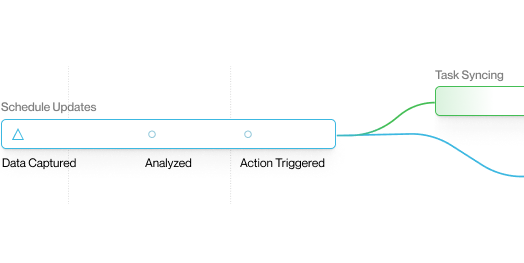
With AI tools for construction companies, that friction eases. The agent works as a real-time information layer – making sure updates, files, and alerts reach the right people without delay.
PROCESS
How Does Customer Service AI Agent Work?
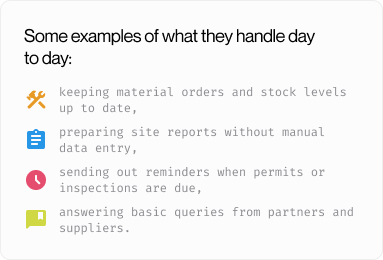
The first step is to decide which of these tasks can be shifted to an AI system. With AI construction tools, the best candidates are repetitive jobs that follow predictable rules. A few common examples:
By setting clear boundaries, companies make sure the agent delivers practical help rather than becoming just another piece of software. One of the biggest benefits of AI in construction at this stage is clarity – teams know what to expect, and trust that the system is there to save time, not complicate workflows.
The first step is to decide which of these tasks can be shifted to an AI system. With AI construction tools, the best candidates are repetitive jobs that follow predictable rules. A few common examples:
When the links are in place, the agent can provide real-time context. If a delivery is delayed, it doesn’t just record the problem – it notifies managers and suggests adjustments to the timeline. This is where the AI impact on construction becomes visible: faster reactions, fewer surprises, and a steadier flow of information between all stakeholders.
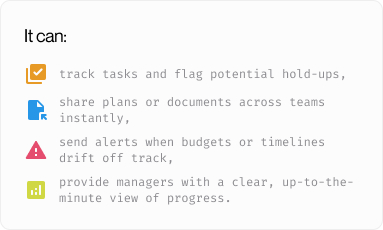
The final step is launch. At first, the agent runs in a limited setting – handling straightforward tasks while teams test and provide feedback. As confidence grows, it takes on more responsibility, from generating reports to sending proactive alerts about risks. Day to day, the Construction AI Agent might:
With each cycle, the system learns more about company rules and project patterns. Over time, this steady learning brings lasting benefits of AI in construction – shorter project timelines, lower admin costs, and better collaboration between office staff and field teams.
By introducing AI to construction, companies gain a practical way to keep projects on track – while freeing people to focus on building, not paperwork.
Benefits of Construction AI Agent
Anyone who’s worked on a building site knows the hard part isn’t pouring concrete.
It’s the pile of updates and approvals that never stops. A delivery is late. A subcontractor doesn’t show. A designer changes the plan at the last minute. One small shift creates a chain reaction – and suddenly the whole crew is waiting around.
This is the gap where construction agents AI prove useful.
Instead of adding more software to the pile, they quietly take over routine tasks and keep everyone connected. The outcome is simple – less time wasted on paperwork, more time spent on the work that moves a project forward.


By using AI tools in construction, these jobs can be automated. The agent can prepare weekly progress notes, track stock levels, or remind subcontractors of upcoming deadlines. People get to spend their hours solving problems on-site instead of typing them into spreadsheets.
That visibility makes decision-making faster. Managers don’t wait days for reports or chase updates by phone. They see what’s happening now and act before small issues turn into bigger setbacks.
In practice, construction agents AI don’t replace human expertise. They clear the noise, handle the repetitive, and leave people free to focus on building.
FAQS
FAQs about Construction AI agents
It doesn’t replace managers or engineers. Instead, it connects to the tools already in use and works in the background. When someone asks for a project update or needs a document, the agent can bring it up right away.
Picture a delivery slipping behind schedule – the agent flags it and notifies the right people. Need a weekly summary? It compiles and shares it automatically. A subcontractor asks for the latest drawing – the agent finds it in seconds.
In the beginning, it usually covers straightforward, repeatable jobs. But with time, it learns patterns: where delays accumulate, which tasks always repeat, how the team prefers to work. Bit by bit, it turns into a dependable coordinator – one that keeps projects moving and frees people to focus on the build itself.
The financial side follows. Fewer delays mean tighter schedules. Automated reporting and tracking cut down on errors that lead to costly rework. Clients see progress on time, which builds trust and makes repeat business more likely.
Companies often notice:
shorter project cycles,
reduced admin overhead,
smoother collaboration across teams and sites,
stronger client satisfaction.
Over the long term, the effect compounds. Each project teaches the agent how the company works – which reports repeat, where delays creep in, what data matters most. With every cycle, it becomes more efficient, while teams spend less energy on routine admin. So, ROI would grow over time.