
Some AI agents take care of simple things such as answering routine customer questions. Others take on bigger jobs. They might predict next month’s demand, compare supplier quotes, or help different teams stay coordinated when work overlaps. The roles vary from one company to another, and that’s the point – knowing which kind of agent fits your situation can make daily operations run smoother and save you from wasting effort where it’s not needed.
This guide walks through the main kinds of AI agents used in business today. Reactive, conversational, learning, autonomous – you will differentiate them easily after reading this article and will be able to choose the right one for your tasks.
The next wave of business automation is already here. The question for most owners isn’t whether to use AI agents but how to make them part of everyday work in a way that feels natural and genuinely useful.
What Are AI Agents and Why Are They Important for Business?
AI agents are quietly changing how companies run their daily operations. Instead of relying only on scripts or pre-programmed rules, these systems can look at data, interpret what’s going on, and act on it – sometimes faster and more accurately than a human could. For many business owners, this isn’t about replacing staff but about freeing them from repetitive work and speeding up decisions.
Think of it as the next natural step in business automation. Traditional software could follow instructions, but would stop the moment something went wrong. What does an AI agent do in such a situation? It analyzes the situation, considers the context, and adapts its behavior to solve the issue.
Here’s an example: a chatbot that answers all incoming messages from clients always gives the same answer. An AI agent that handles customer service support can notice when a message sounds urgent and escalate it automatically before a client loses patience.
The difference in efficiency is real. McKinsey’s Global AI Survey found that nearly eight out of ten companies already use AI somewhere in their organization, and more are connecting separate projects into networks of agents that work together. This shift turns disconnected tools into living systems – the foundation of modern enterprise AI that doesn’t just automate work but understands what the work means.
How Do AI Agents Work?
To put it simply, an intelligent agent is software that pays attention to what’s going on, makes sense of it, and does something useful in response. If the outcome isn’t ideal, it tweaks its approach the next time to improve it. Over countless small adjustments, it quietly gets better at its job – learning the way a good employee learns through experience.
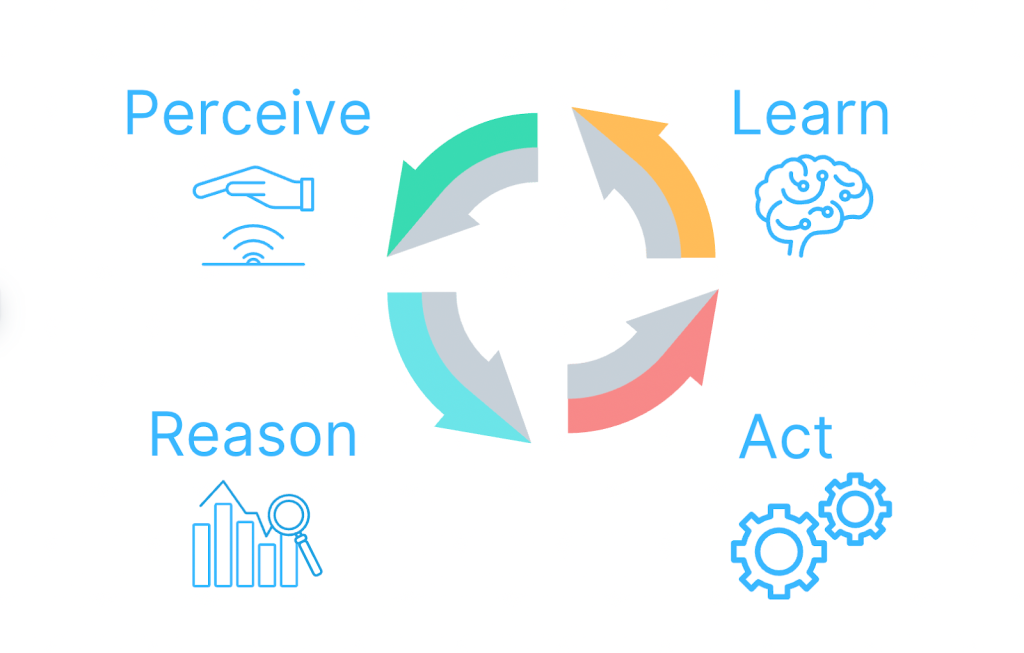
Each agent relies on four abilities:
- Perceiving what’s happening through data or user input.
- Reasoning about the information it receives.
- Acting to carry out a decision.
- Learning from the result and fine-tuning its behavior.
Take a logistics company as an example. Its AI agent monitors weather forecasts, shipping data, and warehouse updates. When it sees a storm coming, it reroutes deliveries before delays occur. Deloitte’s report suggests that this kind of adaptive routing can cut late deliveries by about 20 percent.
What sets these systems apart from old workflow automation is that they don’t just tick boxes – they make judgments. They turn rigid procedures into responsive business systems that adapt moment to moment, much like a skilled employee who learns from experience.
What Types of AI Agents Are Used in Business Applications?
AI agents don’t all serve the same purpose. Some are built to take care of simple, everyday tasks that just need to get done. Others handle decisions that used to require real judgment, learning a little more each time they run. For most companies, the trick is figuring out which kind of agent actually fits the work – something that matches the scale of the business and the problems it’s trying to solve.
Reactive AI Agents
Reactive agents are the simplest form of AI. They follow a fixed set of rules and react instantly when something triggers them. There’s no long-term memory or learning – just a fast, predictable response.
You can spot reactive agents AI in all sorts of everyday tools. Think of a customer-service chatbot that replies with preset answers, an app that checks whether an invoice has been paid, or an email autoresponder that instantly says “got it.” They don’t really think or learn – they just get the job done. That’s what makes them useful.
Another common case is in logistics. A bot that sends delivery updates to customers day and night – we all receive this and don’t even expect them to be “human”.
For most companies, these kinds of reactive agents are the easiest way to start with business automation. They handle the most basic and repetitive chores that don’t require a lot of thinking.
Conversational Agents
You’ve probably talked to one without even thinking about it – maybe when you asked a chat window to check a delivery date or needed help resetting a password. That small exchange is what a conversational agent does best: listens in plain language, follows what you mean, and answers like a person would. Misspell a city, it usually guesses right; switch topics mid-message, it keeps up. Under the hood, it uses natural language processing (NLP) to read intent and carry context from one turn to the next, so the exchange feels like a conversation, not a form.
You’ll find them almost everywhere now – in customer service, sales, and HR. A banking assistant can tell you your balance or freeze a lost card through chat or voice without waiting for a human operator. A travel company might use one to rebook flights, answer itinerary questions, or suggest nearby hotels when plans change.
They’ve quickly become one of the most practical tools in modern process automation. No need to search for statistics and predictions, as evidence shows that even small businesses nowadays use AI chatbot solutions as these become more and more accessible.
Learning Agents
Learning agents are built to evolve. They observe what works, measure outcomes, and adjust their behavior through continuous data feedback. Each new cycle refines their decisions – a practical example of machine learning in action.
Retailers use learning agents to optimize campaigns. After analyzing weekly sales data, an agent might adjust discounts or product placements for each region. In marketing, these systems can test hundreds of ad variations automatically, identifying which message performs best.
Companies using adaptive learning systems notice increased marketing ROI in a short time. Such agents turn raw data into strategic insights, making workflow automation smarter rather than just faster.
Autonomous Agents
Autonomous agents are a step beyond regular automation – they’re what many think of when talking about enterprise AI. Once you set their limits, they can make decisions and act on them without needing constant approval.
Take procurement as an example. An autonomous agent might scan supplier quotes, look at delivery reliability, and even negotiate a better price on its own. In finance, another could shift budgets between departments as expenses change during the quarter. They move faster than manual processes ever could, keeping everything aligned with data instead of instinct.
Because these systems operate independently, they need solid guardrails. Companies usually build in permissions, audit logs, and checkpoints so humans can review what the agent decides. With the right oversight, autonomous agents can speed up decision-making and create a kind of process automation that runs quietly in the background – almost like a living part of the business.
Agentic AI
Agentic AI goes beyond individual smart agents. It connects many specialized systems – in marketing, HR, logistics, finance – into a network that can coordinate entire workflows. Each agent handles its own domain but shares data and goals with the others.
An example can be a manufacturing company with high level of automation, where agents work on different parts of the process, just like employees in different departments. Let’s say there are three agents: one manages inventory, another oversees shipping, and a third monitors equipment condition.
These agents learned to collaborate between them. Together, they can respond to an out-of-order situation that happens, like when a machine doesn’t work properly. They act like any other team would: the maintenance agent alerts the logistics agent to delay shipments and notifies procurement to order parts. They can solve these regular issues without human involvement.
McKinsey (2025) calls this the rise of the agentic organization – businesses where humans supervise, and agents execute most of the process work (McKinsey & Company, 2025). Some large enterprises are already experimenting with these intelligent ecosystems, but we are yet to see where these experiments will lead.
Agentic AI isn’t science fiction anymore. It’s the emerging architecture for how companies will scale intelligence – not by building bigger systems, but by connecting many small, focused agents that think and act together.
Together, these different agents move companies beyond simple automation toward something more adaptive – an operating model that learns, collaborates, and scales with the business itself.
How Do AI Solutions Integrate into Modern Business Systems?
AI agents are starting to sit quietly inside everyday business systems, connecting software that rarely worked together before. Their job isn’t dramatic – it’s mostly about helping things flow. They move information between tools, flag what needs attention, and handle the kind of routine coordination that usually clogs up email threads and project dashboards.
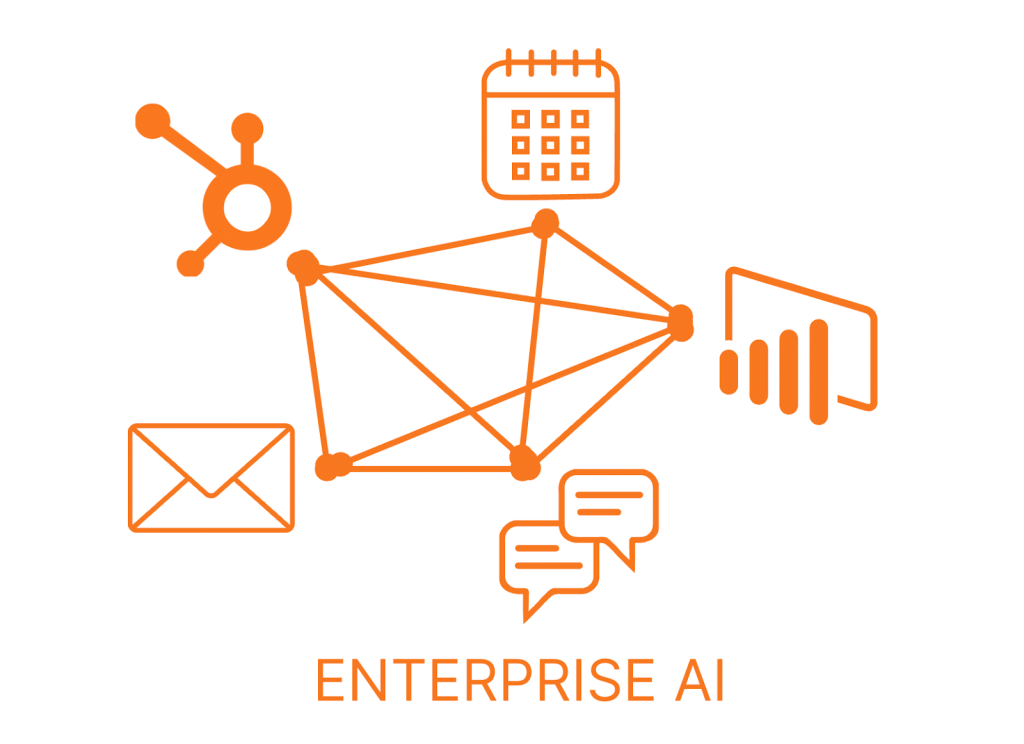
Picture how this works in practice. A sales agent notices a new lead in HubSpot, checks their purchase history, updates a forecast in Power BI, and drops a short summary to the sales team on Slack. No one asked it to do each of those steps separately – it just understands the pattern and carries it through.
Another essential element for integration is process automation layer such as Zapier, Make, or MuleSoft. The purpose of these platforms is to create connections between all the different digital tools: CRMs, finance systems, task management and collaboration apps. Each of those tools was created separately and only later combine into one ecosystem. That ecosystem is called enterprise AI – a network of digital coworkers embedded throughout operations.
For smaller businesses, this integration doesn’t require a full-scale rebuild. Many cloud services already include built-in connectors that let AI agents plug into existing workflows. Starting there allows a company to grow into more advanced forms of business automation, one smooth connection at a time.
How to Choose the Right Type of Agent for Your Company?
Finding the right AI agent isn’t really about chasing the newest technology. It starts with knowing where your business actually struggles. Maybe your team spends hours replying to routine customer questions. Maybe your reports take days to pull together. Or maybe decisions stall because information sits in too many different tools. The right kind of AI agent depends on which of those problems costs you the most time or energy.
For a smaller team, starting with a reactive or conversational agent often makes sense. They’re simple, affordable, and take care of the routine work that tends to pile up. Bigger organizations, already swimming in systems and data, often need learning or autonomous agents – the kind that can sift through information, spot patterns, and act without waiting for a person to press “go.” What matters isn’t chasing the most advanced tool but picking something that fits your workflow and grows with it.
A Few Things Worth Asking Before You Start
- What’s the real bottleneck? Don’t answer right away: first, do some research to find a process that slows work down. Maybe it’s more about reports than handling customer requests.
- How much control do you want to keep? Some agents follow strict rules; others make independent calls. Decide what level of autonomy feels safe.
- Will it plug into what you already use? Agents work best when they can connect with existing CRMs, ERPs, or communication tools through connectors like Zapier or Make, instead of creating additional workflows that need instructions to use.
- Do you have time to maintain it? Simple setups run themselves. Smarter systems need tuning, data cleanup, and oversight. By hiring a professional team to implement your AI agent, you would save time, but it still requires a team member to own the process from your side.
- How will you know it’s working? Choose clear signals – faster response times, fewer manual errors, or shorter approval cycles. Make sure to measure these indicators before and after implementation.
| Company Size | Good First Step | Example | Why It Works |
| Small business | Reactive or Conversational agent | Automated booking or customer replies | Quick win, minimal setup |
| Mid-sized firm | Learning agent | Adjusts marketing spend or stock levels | Learns from results and improves |
| Large enterprise | Autonomous or Agentic AI | Handles procurement or logistics | Connects data across teams, works in real time |
One example comes from HCA Healthcare, a major U.S. hospital network that’s been experimenting with Google Cloud’s generative AI tools to make hospital work a little easier. The goal was to take the edge off the paperwork that keeps doctors and nurses away from patients.
In a pilot program, physicians wear a small, hands-free device that records key points of a consultation. The system turns that spoken information into draft medical notes almost instantly. Doctors then check and approve the notes before they’re added to the patient’s record. What used to take several minutes after each visit now happens while the next patient is walking in. The early feedback from staff has been simple – less typing, fewer late nights catching up on documentation, and more time to focus on care.
Conclusion. Where Intelligent Agent Takes Businesses Next
AI agents are no longer something that belongs only in tech companies or research labs. They’ve already found a place inside everyday business systems, quietly handling the kind of work that used to drain time and attention. From simple chat tools to autonomous systems that coordinate supply chains or clinical workflows, these agents are proving that automation can be both intelligent and practical.
For business owners, the real challenge isn’t deciding whether to use AI – it’s figuring out where it can make the most difference. Starting small often works best. A basic agent that saves a few hours a week can open the door to bigger projects once the value is clear.
Over the next few years, business automation will rely less on single pieces of software and more on connected agents that learn and adapt together. Companies that approach this shift with a mix of curiosity and care – building AI agents that assist people instead of replacing them – will be the ones that get the most out of it.If you’re ready to explore how to create AI agents and how they can fit into your operations, talk to our team. We help businesses design and implement intelligent systems that work with your goals, not just your data.