Artificial intelligence is changing what it means to run a business. AI is affecting the way of working as much as introduction of computers did decades ago.
Ten years ago, automation meant a few lines of code that clicked the same buttons every day. Now it can draft emails, predict delays, and even negotiate delivery schedules – tasks that used to need real judgment. What’s more, it is able to learn on the way and improve its results after facing new challenges (something that not every employee does, frankly). These are AI agents, and in the following years they will shape how companies operate across every industry.
According to McKinsey’s 2024 global survey, 78% of companies have adopted AI in at least one business function. The numbers grew a lot from 55% just a year before.
This article has AI agents explained in plain terms. You’ll learn what makes them different from traditional tools, how they work, what problems they solve, and where their greatest business impact lies in the near future.
How Are AI Agents Different from Traditional Automation Tools
Traditional automation is like a train on fixed tracks. It runs fast but only in one direction. If something blocks the path, it stops. AI agents are closer to drivers who can steer around obstacles.

A typical workflow system performs tasks exactly as designed: collect data, check a rule, move to the next step. It has no sense of context, while AI moves to the goal considering the conditions. It analyzes data and adapts its behavior if something unexpected occurs.
For example, a customer support workflow might assign tickets to available agents. An AI agent approaches the same task differently and in a more nuanced way. It can read each message and provide basic information when the request is simple. But when it recognizes frustration in tone, it can escalate urgent cases immediately. It’s not only faster but smarter.
This flexibility is why AI agents are now seen as the natural evolution of automation. They transform processes from reactive to adaptive, allowing AI solutions for business to handle uncertainty rather than avoid it.
What Technologies Will Power AI Agents in 2025
The rise of AI agents isn’t happening by chance. It’s the result of several technologies quietly reaching maturity at the same time. Large language models now give software the ability to understand and generate language in ways that feel surprisingly natural. Reinforcement learning helps these systems improve through experience, while vector databases give them something close to memory – the ability to recall context rather than start fresh each time.
APIs and integration platforms such as Zapier, Make (formerly Integromat), MuleSoft, and Microsoft Power Automate allow AI agents to connect tools that were never designed to work together. A single agent can pull data from a CRM like HubSpot, process information in Google Sheets, send alerts through Slack, and trigger updates in Salesforce – all without human help.
Another technology that helps AI solutions advance faster is cloud platforms. As they become faster and cheaper, the agents can run continuously, analyzing and responding to events as they happen. Put simply, in 2025, the pieces that used to feel experimental are finally fitting together.
How Are Companies Currently Using AI Agents
Some of the leading AI agent companies are already moving from theory to production. When was the last time you opened a chatbot and had to wait for a real person to answer your question? Now, most of websites uses AI chatbots for customer service, and many start using voice AI agents, too.

There’s a lot more work done with AI that’s invisible from the client side. For example, in finance, agents flag anomalies, monitor transactions, and simplify compliance tasks that used to take hours of manual checking.
Inside large organizations, enterprise AI agents are showing up as digital teammates. They draft reports, summarize meetings, send updates, and help manage projects. At Zentegrio, we develop AI personal assistants that serve all the employees, not just top executives, helping with boring routine tasks and providing all the necessary information on demand.
What Problems Can AI Agents Solve for Modern Companies
Many companies face the same challenge: information scattered across tools and teams. Important data gets trapped in silos, and decisions move more slowly than the market does. AI agents help close those gaps. They can pull from different systems, recognize patterns, and surface what really needs attention.
Let’s take HR & recruiting as an example. It takes a lot of work to hire new people, but not because it requires rare talent or skills. It’s just a load of routine work. One has to scan through hundreds of resumes to find several people to invite for interviews. And then, with inevitable communication lags, candidates will drop out.
Recruiting moves quickly, and small delays can cost great candidates. That’s where an AI agent helps most. It chases overdue feedback, keeps track of responses, and lets the team know when a top applicant might slip away.
The impact shows up in KPIs as soon as the agent steps in. Time-to-hire drops because fewer candidates are stuck waiting in the pipeline. Candidate response rates improve thanks to faster, personalized communication. Altogether, it comes to lower cost-per-hire and a better overall candidate experience.
AI agents don’t replace decision-making – they make it faster and more informed. They take care of the noise so people can focus on strategy, creativity, and the work that truly moves the business forward.
What Technologies Will Power AI Agents in 2025
AI agents are possible because several technologies have matured at the same time. Large language models, reinforcement learning, and vector databases give agents understanding and memory. API integrations let them interact across software ecosystems, while cloud infrastructure provides the speed and scale they need to function in real time.
How Are Companies Currently Using AI Agents
Leading AI agents companies are already deploying prototypes. Retailers use them for product recommendations and inventory management. Logistics firms rely on them to predict delivery delays and reroute shipments. Financial services use them to detect anomalies or automate compliance checks.
In the enterprise space, enterprise AI agents act as digital employees that support analysts, marketers, or engineers. They summarize reports, draft emails, and plan schedules. None of these tasks are revolutionary on their own, but together they add up to hours of saved time every week.
What Problems Can AI Agents Solve for Modern Companies
Most businesses struggle with scattered data and slow decision cycles. Teams spend too much time collecting information instead of acting on it. AI agents remove that friction. They connect across systems, interpret patterns, and surface what matters.
A marketing agent, for instance, can gather data from ads, email campaigns, and customer feedback, then suggest which audience segment deserves attention next. The same logic applies to HR, operations, or finance. Agents make sense of complexity so people can focus on judgment rather than routine.
How Do AI Agents Improve Productivity
The biggest AI agents benefit is time. They take over repetitive work that clogs human schedules. A well-trained agent can draft reports, summarize meetings, or send reminders before deadlines. The gain is not just speed but mental space.
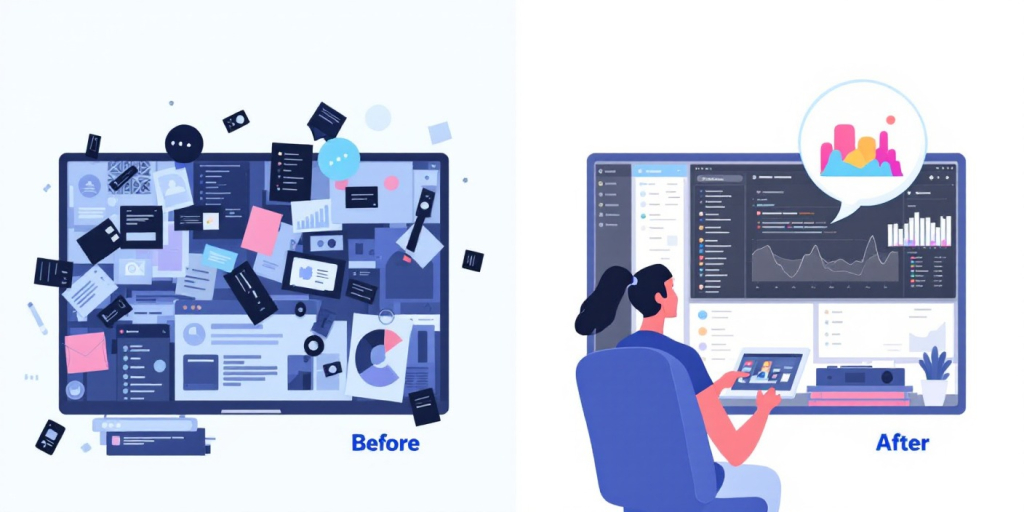
A survey by MIT Sloan found that employees who used AI tools for administrative work saved an average of two hours per day. When multiplied across departments, this becomes a serious productivity advantage.
Agents also reduce context switching. Instead of opening five dashboards, workers can ask an agent a simple question and get a direct answer. It’s like having a colleague who knows every tool in the company.
What Are the Main Challenges in Implementing AI Agents
Building an AI agent is not as easy as turning on a chatbot. There are many difficulties: data privacy, integration with legacy systems, quality assurance, bias, and trust. Employees need to understand what the agent does and how it makes decisions. If the AI agent doesn’t act transparently, humans won’t trust it to work on harder tasks.
Organizations exploring how to create AI agents usually start small – with a narrow function and clear success metrics. Once the model proves reliable, they scale it across departments.
AI Agents in a Business: Industries That Will Gain the Most
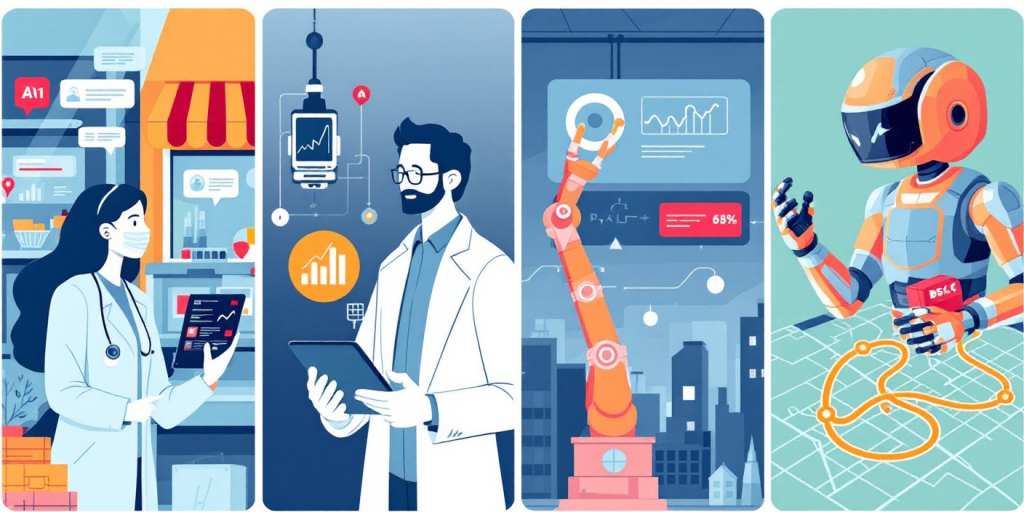
Not every industry moves at the same speed when it comes to using AI agents. The ones who took the risk early and got lucky are already seeing the benefits in their daily operations. But this approach doesn’t work for everyone. Many companies prefer experimenting quietly to figure out what actually works before committing to a full rollout next year.
Take retail and travel, for instance. Customers in these sectors expect quick answers and a bit of personal attention, and that’s exactly where agents fit in. They’re starting to show up at the front lines – helping people find products, rebook flights, or fix small problems without waiting for a human reply. The same approach is reshaping healthcare, where virtual assistants can check symptoms, schedule appointments, and follow up after visits – work that used to take hours of staff time.
Finance and insurance firms use agents for something very different: precision. They comb through long documents, spot unusual activity, and flag potential fraud before it reaches a client’s account. What once took analysts days now happens in minutes.
In manufacturing and logistics, the payoff comes from prediction. Agents keep an eye on machines, anticipate breakdowns, and adjust delivery routes when conditions change. It’s not flashy work, but it saves companies time, money, and a lot of unplanned downtime.
Creative fields — marketing, design, and entertainment — use agents for brainstorming, content generation, and campaign optimization. They accelerate work without diluting originality.
Even the public sector is testing AI for document processing, citizen inquiries, and resource management. Wherever there’s data and a decision, agents find a purpose.
How AI Agents Benefit Competitive Advantage in 2025
As competition grows tighter, companies that integrate agents early will move faster than those that rely solely on human workflows. Agents shrink the gap between insight and action. They don’t just report what happened; they take steps to fix or improve it.
Imagine a sales platform where an agent monitors customer engagement, identifies declining interest, and automatically suggests a retention offer. The agent acts before the issue becomes visible to the human team.
This is how AI solutions for business evolve from automation to intelligence. Maybe for the first time in history, digital program can take decisions on its own, and not just randomly and algorithmycally, but based on data. The data is gold, but in 2025 only those who act on it first can get the most benefit.
Agents also enable personalization at scale. Instead of sending one marketing message to thousands of users, they craft thousands of personalized responses in minutes. That level of precision was impossible with static automation.
Still, success depends on design. Agents need governance and clear objectives to avoid chaos. When built thoughtfully, they become a quiet but powerful source of competitive advantage.
How AI Agents and Workflows Work Together
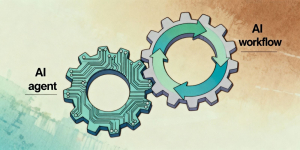
No company runs entirely on free-thinking software. Workflows remain the framework that keeps everything organized. AI agents fill the spaces where structure meets uncertainty.
In customer service, the workflow manages routing and escalation. The agent reads the message, detects emotion, and proposes a solution. In operations, the workflow schedules shipments; the agent predicts weather delays and changes the route.
Together they create a balance between order and intelligence. The workflow offers consistency, while the agent provides adaptability. This blend defines the new generation of AI solutions for business, where automation no longer feels mechanical but responsive.
Many analysts describe this moment as the start of what McKinsey calls an agentic organization – essentially, a company where people and AI systems share the same workflows. In this setup, autonomous agents handle much of the process work from start to finish. So, what’s left for humans? They focus on steering, oversight, and the creative decisions that still need judgment.
Over time, the familiar structure of departments begins to fade. Teams become smaller and shoft from function-based to outcome-focused. The result is faster decision-making, flatter hierarchies, and a company that learns continuously as both people and agents improve over time.
AI Agents Explained Through the Lens of Technology
To understand the coming decade of enterprise AI agents, think about how digital work is changing. Companies no longer want software that simply executes. They want partners that collaborate.
An agent works across APIs, connects with databases, and communicates through natural language. It can summarize a week’s worth of analytics, send an update to a CRM, or even coordinate tasks between departments.
The enabling stack includes:
- Large Language Models for reasoning and dialogue
- Machine Learning for prediction and pattern recognition
- Knowledge Graphs to store relationships between entities
- Voice and Multimodal Interfaces for natural interaction
- APIs and Orchestration Layers for cross-platform action
As these technologies mature, building an agent will become less about coding and more about teaching. Teams will define goals and constraints, and the system will handle the rest.
AI Agents Benefit Businesses in Everyday Operations
AI agents help companies evolve from reactive to proactive. Before angry customers’ feedback gets to decision makers, AI agents can predict the changes and act in advance. Here is how it works in different scenarios.
In marketing, agents track campaign results and adjust budgets automatically. In HR, they screen candidates and schedule interviews. In logistics, they watch inventory levels and reorder supplies before shortages happen.
Each example demonstrates the same pattern – autonomy within boundaries. The agent doesn’t replace employees; it amplifies them. It gives people back their time to think creatively and solve problems that machines still can’t touch.
For managers, this means better visibility. Agents turn raw data into summaries that reveal trends early, helping leadership make faster, more confident decisions.
The Main Challenges Ahead
Security, ethics, and governance are a big concern. Since agents often have access to sensitive systems, strict permissions and audit trails are essential. Reliable authentication will determine which agents can act on behalf of which employees.
Then there’s the human side. Teams must learn how to collaborate with software that thinks differently. Clear communication, defined boundaries, and trust will make or break enterprise adoption.
Forward-thinking organizations are already forming AI agents companies internally – small cross-functional groups that design, train, and monitor these systems. Their lessons will set the standard for the wider market.
How to Create AI Agents for Your Business
Creating an AI agent starts with a question: what task truly needs intelligence? Not every process benefits from autonomy. The best use cases are those with clear goals but variable paths – like handling support requests or optimizing supply chains.
The process usually involves five stages:
- Define the objective – clarify what the agent must achieve.
- Map the environment – identify systems and data sources it will use.
- Design the interaction loop – how it will observe, decide, and act.
- Set guardrails – determine what it can and cannot do.
- Test and refine – allow it to learn safely from real feedback.
Many companies begin with a single pilot project. Once the model proves stable, they scale horizontally to other departments. The secret is to grow gradually and measure impact carefully.
The Future of Enterprise AI Agents
The next phase of business automation will look less like a control room and more like a conversation. Employees will ask their systems for insight instead of running reports. Departments will coordinate through shared agents that manage tasks across boundaries.
In the following years, enterprise AI agents will no longer be seen as futuristic experiments but as necessary components of digital infrastructure.
Companies that adopt early will enjoy all the benefits first: data that learns faster, workflows that evolve naturally, and customers who experience service that feels personal.
Conclusions
AI agents are not a passing trend. They mark a turning point in how businesses think about work itself. Traditional automation brought efficiency. Agents bring understanding.
They learn, decide, and act with context – a quality that transforms them from helpers into collaborators. Workflows will continue to provide structure, but agents will give that structure life. The future belongs to organizations that master both.If you’re curious about how AI agents could fit into your operations, reach out to our team. We build AI solutions for business that grow alongside your company, creating systems that learn, respond, and keep your business ready for whatever 2025 brings.